
On this page
 Artificial intelligence is becoming increasingly common in sports betting, from models that estimate game outcomes to tools that analyze statistics, odds, and betting markets.
But AI does not make sports betting predictable, and using a sophisticated model does not guarantee profitable results.
This guide explains how AI is used in sports betting, how betting models turn data into probability estimates, how sportsbooks use automated systems to price markets, and where AI tools have important limitations.
What Is AI in Sports Betting?
In simple terms, AI in sports betting uses data to estimate how likely different outcomes are, then compares those estimates with sportsbook odds.
Instead, a model assigns probabilities to potential outcomes.
For example, it might estimate that a basketball team has a 62% chance of winning a home game. Bettors can then compare that estimate with the probability implied by sportsbook odds.
Predictive AI vs. Generative AI
 Predictive AI
 uses historical and real-time data to estimate what might happen next. It can analyze player performance, game outcomes, statistical patterns, injuries, and market movements.
Generative AI
Generative AI focuses more on communication, research, and data retrieval. Large language models can answer questions, summarize statistics, explain line movements, and organize information.
However, a chatbot that can discuss recent statistics is not necessarily a specialized probability model. Confident conversational answers do not guarantee accurate predictions.
Not every statistical model used in sports betting is technically considered AI, but the terms are often used together because modern betting systems can combine statistical methods, machine learning, and automated data analysis.
How AI Betting Models Work
 1. Collecting the Data
First, the model needs relevant and reliable data.
For basketball, this might include player efficiency, pace, injuries, rest days, lineup combinations, and home-court advantage. For football, inputs could include expected goals, shot data, possession, player availability, and team performance.
Data cleaning is equally important. Missing information, duplicate records, incorrect entries, and inconsistent dates can distort model results.
Timing also matters. A model should only use information that would have been available at the time a prediction was made. Accidentally including post-game information can createlook-ahead bias and make historical performance appear much better than it would be in real-world betting.
2. Choosing Features
The next step is deciding which variables the model should use. These variables are known as features.
For example, recent defensive performance may provide more useful information than a head-to-head record from several years ago.
3. Training the Model
Developers train models using historical data and known outcomes. Common approaches include:
- Regression models: Used to estimate things like the number of points a team might score, the expected point difference, or the total score in a game.
- Decision trees and random forests: Use a series of questions about teams, players, and other factors to make predictions.
- Gradient boosting: Combines many simple models to gradually improve the accuracy of a prediction.
- Neural networks: More complex models that can look for patterns across large amounts of data.
4. Producing Probabilities
Once trained, the model produces estimated probabilities.
For example:
- Team A: 55%
- Team B: 45%
The 55% estimate is not a guarantee. It represents the model's estimated probability based on the information and assumptions built into the system.
5. Testing and Calibration
A model can perform extremely well on historical data and still fail when presented with new games. This is known as overfitting.
To reduce this risk, developers test models on data that was not used during training.
Calibration measures whether a model's probabilities match what actually happens over time.
For example, if a model gives 100 events a 70% chance of happening, roughly 70 of them should happen if the model is well calibrated.
6. Comparing Model Probabilities With Market Odds
One of the key steps is comparing the model's probability estimates with available sportsbook prices.
For example, if a model estimates a team has a 60% chance of winning while the available odds imply a 52% probability, the difference may indicate that the sportsbook's odds could be offering potential value.
However, a probability gap does not automatically mean a profitable bet. The model could be wrong, the sportsbook's margin must be considered, and the estimated probability itself contains uncertainty.
What Data Does AI Use in Sports Betting?
 Team and Player Metrics
Models can use scoring rates, possessions, usage rates, defensive ratings, player tracking data, injuries, lineup combinations, and other performance metrics.
Contextual Data
Travel distance, rest days, back-to-back schedules, weather, venue, and player availability can also influence predictions.
Historical and Market Data
Historical results can provide useful baseline information, although older data can become less relevant as players, coaches, tactics, and rosters change.
Market data provides another source of information. Changes in sportsbook prices can reflect how the market is responding to new information, betting activity, and changing expectations.
How Sportsbooks Use AI to Set Odds
Sportsbooks use statistical models and automated systems to price markets and manage risk across large numbers of events.
Models can generate baseline probabilities, after which bookmakers incorporate their margin and other risk-management considerations when setting prices.
When new information appears, such as an injury, lineup change, or weather update, automated systems can recalculate prices quickly.
Sportsbooks can also analyze betting activity and market movements when managing their exposure.
AI Betting Assistants: Practical Uses and Limits
 AI assistants can be useful research tools, particularly when they help organize large amounts of information.
Useful Tasks
- Data summaries: Bringing together injury news, recent results, and scheduling information.
- Trend identification: Finding patterns in home/away performance or recent team statistics.
- Market tracking: Explaining changes in betting lines and summarizing available market information.
- Educational queries: Explaining betting terminology, probability concepts, and market mechanics.
Limitations
AI assistants can misunderstand questions, use outdated information, or produce incorrect statements with convincing language. They should therefore be treated as research tools rather than guaranteed sources of betting predictions.
Can AI Actually Beat Sportsbooks?
AI can be used to search for potentially mispriced betting opportunities, but consistently turning those opportunities into profit is difficult.
Predicting an outcome and finding a potentially “mispriced” betting line are two different tasks. A mispriced line is one where the odds may not accurately reflect the true probability of an outcome.
The challenge is not simply predicting more winners; a model's probability estimate must also differ enough from the sportsbook's odds to suggest that a bet may be priced incorrectly.
For example, correctly estimating that a team has a 60% chance of winning does not necessarily create an advantage if the sportsbook's price already reflects approximately the same probability.
Sportsbooks may also have sophisticated models, extensive historical data, real-time information, and substantial market data, although resources vary between operators.
Why AI Betting Models Struggle
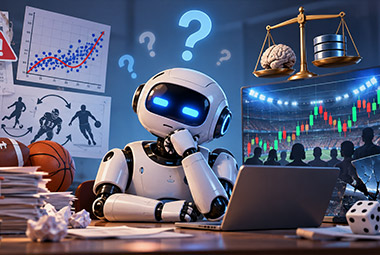 Even a technically sophisticated model faces several challenges that can limit its real-world performance.
Data Quality
Incorrect statistics, missing information, inconsistent records, or outdated data can produce unreliable predictions.
Overfitting
A model can learn patterns that existed in historical data but do not persist in future games. Backtesting evaluates how a model would have performed using historical data. However, strong backtesting results do not automatically translate into real-world performance.
Changing Sports Dynamics
Sports constantly change. Rule changes, coaching strategies, player movement, injuries, tactical developments, and roster turnover can reduce the usefulness of historical patterns.
Market Efficiency
In popular betting markets, many bettors and betting companies are looking for the same opportunities. When lots of people identify the same potential pricing mistake, it can become harder to find an advantage.
Model Bias
Models depend on their assumptions, features, training data, and methodology. If those inputs contain systematic problems, the resulting probability estimates can also be distorted.
Variance and Uncertainty
Even an accurate probability estimate cannot determine the outcome of an individual game.
Unexpected injuries, referee decisions, tactical changes, and random events can all affect results. A model can be statistically sound and still experience losing periods because actual outcomes vary around expected probabilities.
Humans + AI: A Combined Approach
Computers are well suited to processing large datasets, identifying statistical relationships, running simulations, and applying the same methodology consistently.
Human analysts can provide additional context that may be difficult to encode in a quantitative model, such as late-breaking information, tactical changes, or unusual circumstances.
A combined approach can therefore use AI for large-scale data analysis while leaving humans responsible for interpreting the output and questioning whether the model's assumptions still make sense.
Responsible Use of AI in Betting
 Even a well-designed model can produce losing streaks because individual outcomes remain uncertain. The speed and convenience of AI tools can also make it easier to place more bets or take larger risks based on excessive confidence in a model.
Responsible use means treating AI predictions as probability estimates, setting clear financial limits, and recognizing that no algorithm can eliminate the inherent risks of gambling.
AI can make research faster and more systematic, but it cannot remove financial risk.
The Future of AI in Sports Betting
AI is likely to remain an important part of sports betting, particularly as sportsbooks and analysts process increasing amounts of real-time data.
Live betting is one area where AI can be particularly useful because models can process new game information and update probability estimates rapidly.
But wider access to technology does not eliminate competition. If many participants have access to similar tools and information, advantages can depend on data quality, processing speed, model design, and the ability to interpret information correctly.
Ultimately, AI remains a tool for working with probabilities. And in sports, probabilities never guarantee an outcome.
Frequently Asked Questions
Can AI predict sports betting outcomes?
AI can estimate the probability of different outcomes using historical and real-time data, but it cannot predict individual results with certainty.
Can AI beat sportsbooks?
AI can identify potential pricing discrepancies between its probability estimates and sportsbook odds, but consistently turning those discrepancies into profit is difficult. Bookmaker margins, market competition, model uncertainty, and variance all make sustained profitability challenging.
What data does AI use for sports betting?
Depending on the sport and market, models can use player statistics, team performance, injuries, lineups, schedules, weather, historical results, and betting-market data.
What is the difference between predictive AI and generative AI in sports betting?
Predictive AI is designed to estimate future outcomes or probabilities, while generative AI is primarily designed to generate and organize information, answer questions, and communicate with users.
Can ChatGPT predict sports bets?
A general-purpose AI assistant can analyze and explain information, but that does not make it equivalent to a specialized sports prediction model. Its outputs can also contain errors or rely on incomplete or outdated information.
Are AI betting predictions guaranteed to be profitable?
No. A model's predictions are probability estimates, and even accurate estimates can produce losing results over individual games or periods of time.

Written by Alexis Gold Alexis Gold
Senior Content Writer
Expert On: Casino reviews Software reviews Sweepstakes and Social Casinos

Fact-checked by Nina.D Sylvanas
Chief Content Editor











Share on
Twitter
Facebook
Delicious
Reddit
Copy Page URL