
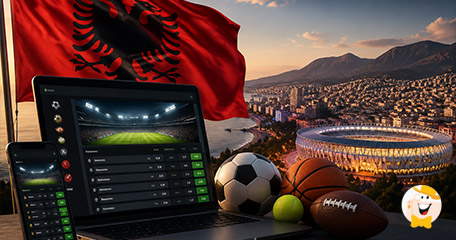
Albania is preparing to reopen its online sports betting market after years of prohibition, with the new framework allowing up to 10 operators to obtain licences. Licensed sports betting was banned from December 2018, while lawmakers approved its return through legislation in 2024.
The move follows evidence that betting continued through the unregulated market. Unregulated online sports betting generated an estimated $117 million in gross gaming revenue (GGR) in 2024, rising to $126 million in 2025. Including online casino and poker, total unregulated online GGR reached about $229 million last year.
Strict requirements for operators
The revised framework requires applicants to establish an Albanian joint-stock company and maintain at least ALL40 million (€400,000) in share capital. They must also demonstrate gambling experience across at least three EU or OECD markets and report turnover of at least ALL2 billion (€20 million) in the previous financial year.
Applications will be assessed under a 100-point system. The financial offer and gambling experience each carry 30 points, while governance and organisation account for 20. Technology and software receive 15 points, with five points assigned to a three-year business plan.
Legal expert Hendri Hanaj said the requirements appear likely to favour established international operators.
“There are a lot of conditions to get the licence and no Albanian company, at least, would be able to meet them – or at least none that are interested in betting,” he explains. “It’s not that Albanian companies are not capable – of course they are capable of being compliant. I think the government is looking for companies that have been doing this for many years, which would be better for the market.”
Online-only market faces oversight
Retail betting shops and slot halls will remain prohibited. Players must register using a national identity card, while cash betting will be banned. Payments must pass through Albanian banks, licensed electronic money institutions or approved payment providers.
Operators must monitor transactions, retain player records for at least three years and enforce the national self-exclusion register. They must also provide information about gambling risks and available support.
Two violations within three years can lead to a licence suspension lasting between 30 days and two years. A third violation can result in revocation.
Albania currently has no dedicated gambling counselling or rehabilitation centre, raising concerns about support for gambling-related harm.
Operators will pay 15% of GGR into a special fund, alongside the standard 15% corporation tax, local taxes and licence fees. The minimum licence fee is ALL400 million (€4 million), payable over the 10-year licence term.
Licensing process still pending
The Albanian Council of Ministers approved Decision No. 194 on March 26, 2026, establishing procedures for issuing up to 10 licences. Applicants will have 45 calendar days to submit applications once the competition opens.
In July, authorities said all eight implementing regulations had been finalised. The Ministry of Finance confirmed the legal framework was ready, while noting that licensing had yet to officially begin.
“There is an appetite for sports, but it has faded over time,” Hanaj says. “People like my father, or my cousins who are older than me, like sports more. Of course, people will bet, but I don’t think it will be as massive as before.”
Source:
“As Albania prepares to bring sports betting out of the shadows, conditions favour international operators”, igamingbusiness.com. August 17
“requirements appear likely to favour established international operators”

Written by Luka.J LukaVic
News Reporter
Expert On: iGaming News Gambling Regulations Predatory bonus terms

Fact-checked by Nina.D Sylvanas
Chief Content Editor









Neskez 2 months ago
Moderator
A regulated market is always a better alternative to an unregulated one. Albania’s reopening could improve player protection while creating new opportunities for licensed operators.
Please enter your comment.
Your comment is added.