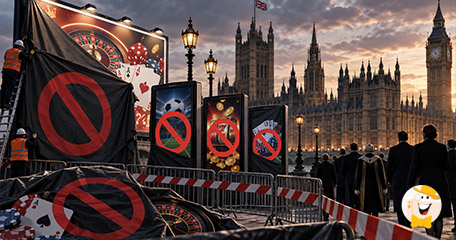
A House of Lords committee has recommended a comprehensive ban on gambling advertising as part of a renewed public-health approach to gambling-related harm in Great Britain. The proposal appears in Gambling Harm—Time for Action: Follow-up report, published on September 17, 2026, six years after an earlier parliamentary inquiry examined the social and economic effects of the gambling industry.
The cross-party committee estimates that between 1.0 million and 1.5 million adults in Great Britain experience gambling patterns that may qualify as problem gambling. Separate figures cited alongside the report put this at about 2.4% of adults aged 18 or older. The committee associated problem gambling with relationship difficulties, reduced spending on everyday needs, use of savings or borrowed funds, and dishonesty toward family members. It also highlighted links with mental ill health and suicide in the most serious cases.
The report argues “that a comprehensive ban on gambling advertising represents the most effective policy option to advance meaningfully the Government’s aim of reducing gambling harms and represents a vital part of a public health approach.”
Committee Points to Advertising Growth and Harm
Advertising rules changed substantially after the Gambling Act 2005 liberalised the market. Before that shift, television and radio promotion remained limited to bingo, football pools, the National Lottery and other permitted lotteries.
The committee said gambling advertising has expanded sharply since 2005 and stated that the industry now spends more than £1 billion each year on advertising. A World Advertising Research Center estimate cited in the additional material placed UK gambling companies’ advertising expenditure at £2 billion last year.
Researchers who contributed evidence to the debate also linked advertising exposure with increased participation. Dr. Raffaello Rossi said the “evidence base is incredibly clear on the link between gambling advertising and participation.” Research involving football viewers found that fans exposed to gambling ads during World Cup matches were 22% to 33% more likely to place bets. Dr. Matt Gaskell also pointed to evidence suggesting that advertising can increase gambling frequency and spending.
The report acknowledged the difficulty of proving a direct causal relationship in every case. However, it argued that this uncertainty should not prevent regulatory action because the wider evidence indicates that advertising increases participation and can contribute to harm.
The committee also criticised previous government responses to the expansion of digital advertising and newer promotional methods. It raised concerns about content marketing that can blur the line between advertising and editorial material and appeal strongly to children.
Industry Raises Economic and Illegal-Market Concerns
The Betting and Gaming Council has opposed a blanket prohibition. The trade body argues that licensed operators already take voluntary measures to limit advertising and that stricter controls could weaken the regulated sector while increasing the appeal of unlicensed gambling businesses.
BGC chief executive Grainne Hurst said members have reduced advertising expenditure, allocated 20% of advertising space to responsible gambling messages and introduced voluntary restrictions around live sport.
Hurst said: “A blanket advertising ban would remove a key competitive advantage of being licensed and regulated while doing nothing to stop illegal operators targeting British consumers.”
The economic debate comes as major gambling companies have announced job reductions. Entain said it would cut 400 positions, while bet365 announced 340 job cuts, equal to about 3% of its UK workforce. The BGC has attributed around 4,500 sector-wide job losses to tax increases introduced in the previous UK budget, particularly those affecting online casino gambling.
The committee questioned the argument that tighter advertising rules would necessarily push large numbers of consumers toward illegal operators. It said the available evidence did not substantiate claims of widespread displacement and argued that illegal-market concerns should not prevent action against harms associated with the licensed sector.
Jim Curry of the Better Gaming Show expressed a different view. “In everything, I like to see a balance; otherwise, it just drives gambling underground and into the black market, where there’s no protection at all,” he said.
He added: “I believe in tighter restrictions on advertising on things like bonuses and promotions/enticements, but a blanket ban on advertising and sponsorship goes too far.”
Report Sets Out Economic Case for Restrictions
The committee also examined the wider economic consequences of reducing gambling participation. It acknowledged that an advertising ban would be “highly likely” to produce “a negative net impact on the sector.” However, it argued that lower levels of problem gambling could reduce associated economic costs and redirect some consumer spending elsewhere.
Lord Foster of Bath cited research from the Sheffield Centre for Health and Related Research when discussing the potential impact. He said: “There are clear health and economic benefits to reducing participation in gambling, with a recent study by the Sheffield Centre for Health and Related Research estimating that a 10% reduction in spending on gambling could lead to an increase in GVA of £1.25 billion and create over 22,000 jobs.”
International experience also features in the debate. The Netherlands banned gambling advertising on radio and television in 2023 and later introduced restrictions on sports sponsorship. Operators reported a 35% fall in new player registrations immediately after the advertising ban. The Dutch regulator has also reported increased gambling at unlicensed sites while maintaining that the restrictions have reduced exposure among young adults and vulnerable groups.
The committee recommended exemptions for on-course betting advertising at horseracing and greyhound racing events, repeating a position from the 2020 inquiry. It also called for an assessment of the risks associated with lottery advertising before deciding whether lotteries should fall within a comprehensive prohibition.
If the Government rejects a full ban, the report includes further recommendations for tighter advertising regulation and measures that could apply during a transition period.
The recommendations follow other changes in UK gambling policy, including the 2023 White Paper and the introduction of a statutory levy to fund research, prevention and treatment. The Government will now consider the report and decide whether to adopt its proposals.
Source:
"Comprehensive ban on gambling advertising recommended by new Lords report", committees.parliament.uk, September 17, 2026.

Written by Luka.J LukaVic
News Reporter
Expert On: iGaming News Gambling Regulations Predatory bonus terms

Fact-checked by Nina.D Sylvanas
Chief Content Editor