
Prediction Markets
Prediction markets are online marketplaces where people trade event contracts based on whether a specific real-world event will happen. Most use simple Yes or No contracts, with prices changing as traders react to news and new information. Prediction markets can cover everything from sports and economic events to entertainment, weather, and other real-world outcomes, and traders can often buy or sell their position before the event is resolved. In simple terms, they combine forecasting with market-style trading, using prices to show the crowd’s current view of what is most likely to happen.
Prediction markets have existed in the United States in their modern form since 1988, when the Iowa Electronic Markets launched, while event contracts have traded in federally regulated markets for more than two decades. However, the current rise of prediction markets really began around the 2024 US presidential election, when platforms such as Polymarket and Kalshi moved from a relatively niche corner of trading into mainstream attention. Millions of people started following market prices as a live indication of how traders viewed an election outcome, even if they never placed a trade themselves. The next major step came in 2025, when sports contracts became much more prominent and mainstream financial apps such as Robinhood started offering event-based contracts. That changed prediction markets from something people might check during a major election into a product with new things to trade every day.
Their appeal is fairly easy to understand. Instead of learning complicated financial products, users can answer a simple question: will something happen or not? A contract might ask whether a team will win, if interest rates will change or if a particular event will occur. Users buy “Yes” or “No” positions, with the price reflecting the market’s current view of the probability. That simplicity, combined with mobile trading, social media discussion and the ability to trade on subjects already dominating the news, has helped prediction markets attract people from several different audiences at once. By August 2026, Kalshi and Polymarket together were handling tens of billions of dollars in monthly trading volume.
Their connection to iGaming became especially important once sports entered the picture. A prediction-market contract on whether a football team wins can look very similar to a sportsbook bet from the user’s perspective, even though the companies describe and regulate the transactions differently. This similarity has fueled the ongoing Prediction Markets vs Sports Betting debate over whether sports event contracts should be treated as financial products or conventional wagers. Traditional sportsbooks operate under state gambling laws, while platforms such as Kalshi argue that their event contracts are federally regulated financial derivatives. That allows prediction markets to operate in some places where conventional online sports betting is restricted, which has brought them into direct competition with sportsbooks and triggered disputes involving gaming regulators, lawmakers and gambling-industry groups. Sports therefore did more than increase their popularity: it placed prediction markets directly alongside the established sports-betting industry and made them a major iGaming issue.
What Is a Prediction Market?
A prediction market is a marketplace where participants trade contracts based on the outcome of an event that takes place in the future.

These contracts, often referred to as event contracts, derive their value from whether a specified event occurs or a particular outcome is achieved.
Prediction markets can be used for speculation, hedging, and forecasting. A typical event contract defines a specific event or outcome, has a market price that reflects participants’ expectations, offers a potential payout based on the settlement result, and includes an expiration or settlement point at which the contract is resolved.
Many contracts use a yes-or-no structure.
For example, imagine a contract asking:
"Will it rain tomorrow?"
If the YES contract trades at 70 cents and pays $1 if the event occurs, a trader buying one contract for $0.70 could receive $1 if it rains. That represents a potential 30-cent gain before applicable fees and taxes.
If it does not rain, the contract settles at $0, and the trader loses the $0.70 paid.
The 70% figure is an implied probability, not a guarantee. It is an estimate derived from the market price at a particular moment.
Are Prediction Markets Legal?
The legality of prediction markets depends on the platform, the type of event contract, and the jurisdiction. There is no single global regulatory model. Some countries treat prediction markets or certain event contracts as financial products, while others may classify them as betting or gambling products or restrict them if they do not fall within an existing licensing framework.
In the United States, some prediction markets operate within the federal derivatives framework overseen by the Commodity Futures Trading Commission (CFTC). The CFTC has argued that event contracts traded on registered markets fall under its jurisdiction as commodity derivatives. However, the legal position is still being tested, particularly for sports prediction markets. State gaming regulators and Tribal governments have challenged the idea that federal registration prevents state or Tribal gambling rules from applying to sports-related contracts, and court decisions in 2026 have produced important limits in some jurisdictions. As a result, it is more accurate to say that the legality and availability of prediction markets in the US can depend on the operator, contract and location rather than assuming that every market is legal nationwide.
Outside the US, regulation is developing in different directions. Gibraltar introduced dedicated Prediction Market Regulations in July 2026, creating a specific authorisation regime for prediction-market activity rather than simply treating every product as conventional betting or gaming. Malta has taken a broader approach: the Malta Gaming Authority has indicated that some prediction-market products may already fall within its existing licensing categories, including fixed-odds betting and peer-to-peer or exchange-based betting, depending on how the product is structured. Across Europe more generally, there is still no single prediction-market framework, so treatment can vary considerably from one country to another.
How Do Prediction Markets Work?
Prediction markets bring together buyers and sellers who have different expectations about what will happen. The market price reflects those expectations and can change as participants respond to new information.
Suppose a contract asking if a team will win is trading at 60 cents. A trader who thinks the outcome is underpriced may buy YES, while another participant may take the opposite position.
An injury to a key player, an unexpected economic announcement, or a major political development could cause traders to revise their expectations and move the price.
A Simple Example
Suppose you buy 10 YES contracts at 60 cents each.
Your initial cost is:
10 × $0.60 = $6
If the event occurs and each contract pays $1, you receive:
10 × $1 = $10
Your gain is therefore $4 before fees and taxes.
You do not necessarily have to wait until settlement. If new information causes the contract price to rise from 60 cents to 75 cents, you may be able to sell the 10 contracts for approximately $7.50, producing a $1.50 gain before costs. If the price falls, the value of your position declines.
This means a prediction-market position can gain or lose value before the underlying event is resolved.
What Do Prediction Market Prices Mean?
In a simple yes-or-no market, the contract price can often be interpreted as the market's implied probability.
For example:
- 20 cents ≈ 20% implied probability
- 50 cents ≈ 50% implied probability
- 80 cents ≈ 80% implied probability
These are market estimates, not guarantees.
An 80-cent contract does not mean an event has an objectively established 80% chance of occurring. It means traders are currently pricing that outcome at approximately 80%.
Prices can change substantially before settlement as new information becomes available.
What Happens When a Market Resolves?
When the outcome becomes known, the contract is settled according to the market's rules.
In a traditional binary contract, the winning outcome pays $1 while the losing outcome pays $0.
The settlement rules determine what counts as the winning outcome. Contracts can use different criteria, data sources, and methodologies.
Before trading, check:
- What event determines the outcome
- Which source or methodology determines the result
- Who makes the settlement determination
- When the contract expires
- How the final payout is calculated
Two contracts that appear similar can have different settlement rules, so reading the contract details can be just as important as comparing prices.
What Can You Trade on a Prediction Market?
For an event to work as a contract, its outcome generally needs to be clearly defined and measurable under predetermined settlement rules. Prediction markets can cover many types of measurable events, including:

Politics and Elections
Political markets can cover election outcomes and other political events.
Election markets played an important role in the development of prediction markets. The Iowa Presidential Stock Market, created in 1988 at the University of Iowa, is often described as the first modern prediction market.
Sports
Sports represent one of the most prominent areas of growth for prediction markets. Contracts can be based on a wide range of measurable outcomes, including game winners, point spreads, totals, player-related outcomes, futures, and other specific sports events. These contracts also carry implied odds: their market prices reflect the probability traders assign to an outcome and can be converted into familiar betting-style odds.
From a user’s perspective, sports event contracts can appear similar to traditional sports wagers because both involve taking positions on the outcome of a sporting event.
However, their market structures and legal treatment can differ. In the United States, the classification and regulation of sports-related event contracts have become the subject of an ongoing regulatory debate.
Economics and Financial Events
Prediction markets can also cover a range of economic and financial events, including Federal Reserve interest-rate decisions, inflation data, employment figures, and other economic indicators.
These contracts allow participants to express views on future economic conditions by trading based on whether a specific economic outcome will occur.
Weather
Weather markets can cover measurable outcomes such as temperature levels, freezes, rainfall, and other defined conditions.
They can have both speculative and hedging applications.
Entertainment and Culture
Prediction markets can also cover measurable outcomes in entertainment and culture, including award shows, box office results, television ratings, and other clearly defined entertainment events.
In general, an event can potentially become the subject of an event contract when its outcome can be objectively measured, clearly defined, and attracts sufficient interest from participants.
Why Do People Use Prediction Markets?
There are three broad reasons to participate: speculation, hedging, and forecasting.
Speculation
Some traders believe they can identify outcomes that the market has mispriced.
If a trader believes an event is more likely than its current price suggests, they can take a position accordingly. If the price subsequently moves in their favor, they may be able to sell for a profit or receive the contract's payout at settlement.
The market can also move in the opposite direction, resulting in a loss.
Hedging
Event contracts can potentially offset certain real-world risks.
For example, a citrus farmer concerned about losses from a sudden freeze could potentially use a weather-related event contract as a hedge.
The usefulness of a hedge depends on how closely the contract's outcome corresponds to the underlying financial risk.
Forecasting
Prediction markets can aggregate information and opinions from many participants.
Because traders have financial incentives to assess information and form expectations, market prices can sometimes provide useful forecasts. Prediction-market forecasts have been used and discussed by economists, analysts, pollsters, media organizations, and others.
Markets are not always correct. Their usefulness depends on factors such as participation, available information, liquidity, contract design, and market conditions.
How to Choose a Prediction Market
Choosing a prediction market involves more than comparing the number of markets or the lowest advertised fee. The right platform depends on the events you want to trade, the costs involved, market liquidity, funding options, availability, and the regulatory framework that applies to the product.
Market Selection
Start with the events you actually want to trade. Some platforms offer a broad range of markets, while others focus more heavily on sports, politics, economics, weather, or other categories.
A platform with more markets is not necessarily more useful if it does not offer the contracts you are interested in.
Liquidity and Market Conditions
Liquidity affects how easily you can enter or exit a position and the price at which your trade is executed. Less-active markets may have fewer buyers and sellers, which can make it harder to complete larger trades at the displayed price.
Before placing a trade, review the available bids and offers, trading activity, and the difference between the prices at which buyers and sellers are willing to trade.
Fees and Costs
Platforms can use different fee and pricing structures, and these may change over time. Review the current costs for the types of contracts and trading activity you expect to use.
Consider not only advertised fees but also the price at which your trade is actually executed and any other applicable charges.
Funding and Withdrawals
Payment methods vary between platforms. Depending on the platform, funding options may include bank transfers, debit cards, credit cards, wires, PayPal, or cryptocurrency.
Before depositing money, check the available funding and withdrawal methods, processing times, minimum and maximum amounts, applicable fees, and any restrictions that may apply.
Availability
Platform and product availability can vary by jurisdiction and can change as regulations, court decisions, platform policies, and market structures develop.
A platform or particular type of event contract may be available in one jurisdiction but unavailable or restricted in another. Check the platform's current availability information and the rules applicable to your jurisdiction before opening an account or depositing money.
Regulation and Customer Protections
The regulatory framework can differ depending on the platform, product, and jurisdiction. Before trading, identify the legal entity operating the platform, understand what rules govern the product, and review how customer funds are handled and what protections may apply.
Read the platform's contract terms, settlement rules, risk disclosures, and other relevant documentation before depositing funds.
This is particularly important for sports-related event contracts, where federal regulators, state regulators, Tribal governments, sports organizations, gaming companies, and other stakeholders have taken different positions regarding their classification and regulation.
Prediction Market Platforms: Kalshi, Polymarket & Alternatives
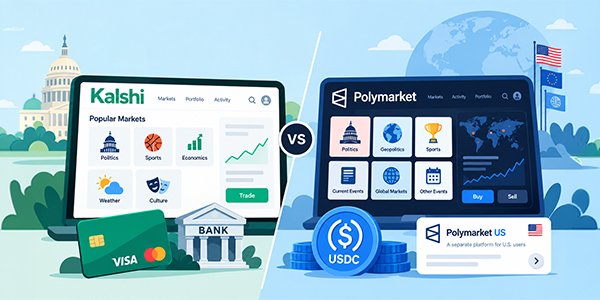
Two of the best-known names in prediction markets are Kalshi and Polymarket, but they are not the only options. Other platforms, including Robinhood, Crypto.com, and newer entrants, also offer event contracts or prediction-market-style products.
Kalshi
Kalshi offers event contracts across areas such as politics, sports, economics, weather, and culture.
Its use of conventional funding methods can appeal to users who prefer to fund an account through banking or card-based payment options rather than cryptocurrency.
Polymarket
Polymarket is particularly known for political and geopolitical markets, along with sports and other event categories.
Its international platform uses USDC, a cryptocurrency designed to maintain a value close to the US dollar. Polymarket US operates as a separate platform with its own products and availability.
Other Alternatives
The prediction-market landscape also includes products from established financial and sports-betting companies, as well as newer entrants.
Since features and availability can change, compare platforms based on the specific markets you want to trade rather than relying solely on overall market size or brand recognition.
Prediction Markets vs. Traditional Sportsbooks
Prediction markets and sportsbooks can look similar when someone is trying to predict a sports outcome, but their structures can differ.
Prediction-market contracts are generally traded through a marketplace, with prices changing according to buying and selling activity.
Traditional sportsbooks typically offer wagers under a different structure, with the sportsbook setting odds and accepting bets according to the applicable wagering framework.
The distinction matters because a product that looks like a sports bet to a customer may have a different legal and regulatory structure.
In the United States, the classification of certain sports event contracts is being contested by federal and state authorities, Tribal governments, sports organizations, gaming companies, and other stakeholders.
The regulatory treatment therefore cannot be assumed to be identical across prediction markets and traditional sportsbooks.
| Prediction market | Sportsbook |
|---|---|
| Contracts traded through a marketplace | Sportsbook sets the odds and accepts bets |
| Prices change with buying and selling activity | Wagers placed under the applicable wagering framework |
| Platforms such as Kalshi argue their contracts are federally regulated derivatives | Operates under state gambling laws |
| Classification of sports contracts is contested in the US | Established regulatory treatment |
Risks of Prediction Markets and How to Manage Them
Prediction markets involve financial risk, and no event contract is guaranteed to produce a profit. Understanding the contract, the platform, and the potential outcomes can help traders make informed decisions about the risks they are taking.

Market Risk
The most direct risk is that an event does not occur as expected and the contract settles against your position. A contract can also lose value before settlement if new information causes market participants to revise their expectations.
For example, if you buy a YES contract for 60 cents and its price later falls to 30 cents, the market value of your position has declined. If the contract ultimately settles at $0, you lose the amount originally paid for the contract, excluding any applicable fees.
Liquidity Risk
A contract's displayed price does not necessarily mean you can buy or sell any quantity at that price. In less-active markets, there may be fewer buyers and sellers, making it harder to enter or exit a position, particularly when placing larger orders.
Limited liquidity can also result in greater price differences between the available bids and offers or cause a trade to be executed at a less favorable price than expected. Consider the market's trading activity and available bids and offers before entering a position.
Settlement Risk
A contract may settle differently from what a trader expects if its rules are misunderstood. Before trading, review the contract's outcome criteria, settlement source, expiration time, and payout calculation.
Pay particular attention to how ambiguous or unusual outcomes are handled. Two contracts that appear similar can have different settlement rules, so the contract's official terms should be treated as the final reference for determining how a position will be resolved.
Platform and Regulatory Risk
Platform terms, market availability, and regulatory treatment can change over time. A product that is available in one jurisdiction may be unavailable or restricted in another, and regulatory developments may affect how certain event contracts are offered.
Before depositing funds, verify the platform's current availability, applicable rules, fees, and official terms. Use the platform's legitimate website or application, and be cautious of services that promise guaranteed profits, unusually large returns, or "free money."
Cryptocurrency and Technology Risk
Cryptocurrency-based prediction markets can involve additional risks related to cryptocurrency custody, transfers, smart contracts, and the underlying technology.
These risks are separate from the risk that the event contract itself will settle against your position. Users should understand how funds and contracts are held and what technical or counterparty risks may apply.
Managing Your Risk
Risk management starts with deciding how much money you can afford to lose before entering a position. Consider the potential loss, total trading costs, liquidity, and the possibility that you may not be able to exit at the price you expect.
Monitor open positions and stay aware of developments that could affect both the underlying event and the contract's market price. Where available and appropriate, tools such as stop-loss orders may help manage an open position, although they cannot eliminate the risk of losses or guarantee execution at a particular price.
The goal of risk management is not to eliminate risk. It is to understand the potential outcomes, costs, and limitations of a position before committing money to it.
Prediction markets should generally be approached with risk capital, money you can afford to lose without affecting essential expenses, financial obligations, or savings.
The Future of Prediction Markets
Prediction markets are expanding beyond their traditional political and economic applications, with sports emerging as a significant area of growth. This expansion has also intensified questions about how event contracts should be classified and regulated.
As of 2026, the regulatory treatment of certain event contracts remains an active issue in the United States. Developments involving federal and state authorities could affect the availability and structure of some markets, particularly sports-related contracts.
The debate involves a range of stakeholders. State attorneys general have argued that sports wagering belongs within state regulatory systems, while Tribal governments have raised concerns involving sovereignty and existing gaming frameworks.
Sports organizations have called for safeguards related to integrity, information sharing, insider trading, athlete welfare, and customer verification. Gaming companies and state regulators have also raised issues associated with traditional sports betting.
At a broader level, the debate concerns how event contracts should be distinguished from traditional gambling products and how regulatory responsibilities should be divided among federal, state, and Tribal authorities.
For participants and businesses in the prediction-market industry, changes in this regulatory landscape could affect which products are offered, where they are available, and how they are structured.
Play responsibly!

Written by Alexis Gold Alexis Gold
Senior Content Writer
Expert On: Casino reviews Software reviews Sweepstakes and Social Casinos

Fact-checked by Nina.D Sylvanas
Chief Content Editor
Prediction Markets: 1



FAQ's
How do prediction markets work at online casinos?
Which online casinos offer prediction betting?
How does prediction betting work at an online casino?
Are casino prediction markets the same as sports betting?
What can you trade on a prediction market?
Are prediction markets gambling?
Are prediction markets legal in the United States?
Can I play casino games and use prediction markets at the same online casino?

Join today and start earning rewards
You will immediately get full access to our online casino forum/chat plus receive our newsletter with news & exclusive bonuses every month.

